
Friday, December 19, 2014
Required Viewing - Rabbit and Deer
Rabbit and Deer (Nyuszi és Őz) from Péter Vácz on Vimeo.
Thanks to Teoh Yi Chie of Parka Blogs for the link.

Thursday, December 18, 2014
Required Reading - Paul Graham on Doing What You Love
Defining "What You Love"
"It used to perplex me when I read about people who liked what they did so much that there was nothing they'd rather do. There didn't seem to be any sort of work I liked that much. If I had a choice of (a) spending the next hour working on something or (b) be teleported to Rome and spend the next hour wandering about, was there any sort of work I'd prefer? Honestly, no."This distinction is critical - it seems all too easy to decide that all you want to do is relax on the beach, and you should just accept that work will always be unpleasant. We all know people who feel this way, right?
"The rule about doing what you love assumes a certain length of time. It doesn't mean, do what will make you happiest this second, but what will make you happiest over some longer period, like a week or a month.
[ . . . ]
You have to like what you do enough that the concept of "spare time" seems mistaken."So when the mindless pleasures become unsatisfying, what will satisfy you?
"To be happy I think you have to be doing something you not only enjoy, but admire. You have to be able to say, at the end, wow, that's pretty cool."There are lots of ways to lead a fun life, but given the choice, wouldn't you rather create or at least contribute to something magnificent? (And this isn't a choice, because magnificent things are usually fun too!)
Discovering "What You Love"
"That's what leads people to try to write novels, for example. They like reading novels. They notice that people who write them win Nobel prizes. What could be more wonderful, they think, than to be a novelist? But liking the idea of being a novelist is not enough; you have to like the actual work of novel-writing if you're going to be good at it; you have to like making up elaborate lies."Uh oh. Time to think hard - have you been pretending to be something you aren't? I have just realized that I might not be a writer. In fact, I've never written a story in my spare time. How foolish! But better late than never, I suppose.
"Another test you can use is: always produce. For example, if you have a day job you don't take seriously because you plan to be a novelist, are you producing? Are you writing pages of fiction, however bad? As long as you're producing, you'll know you're not merely using the hazy vision of the grand novel you plan to write one day as an opiate. The view of it will be obstructed by the all too palpably flawed one you're actually writing.
"Always produce" is also a heuristic for finding the work you love. If you subject yourself to that constraint, it will automatically push you away from things you think you're supposed to work on, toward things you actually like. "Always produce" will discover your life's work the way water, with the aid of gravity, finds the hole in your roof."So. Think - whatever it is, this work that you love, it has to be something that you are willing to do even if you aren't paid for it, in your spare time. Ask yourself if you can narrow it down.
In the past 10 years, I've discovered that procrastination is the most obvious indicator.
- I thought I wanted to be an architect. When I landed a job designing custom homes, I procrastinated for weeks on end.
- I studied ceramics in college, built a ceramics studio in my garage after graduation and took 2 years to create one kiln load.
- In 2012, I decided to make comics my career, and I am procrastinating on the final edits for our first issue AT THIS VERY MOMENT.
. . .
. . .
. . .
Note to self: think on this one more.
Getting The Job
Further down in the article, he describes two options for getting into the career you love - the "Organic" method and the "Two-Job" method.If you're sure of the general area you want to work in and it's something people are likely to pay you for, then you should probably take the organic route. But if you don't know what you want to work on, or don't like to take orders, you may want to take the two-job route, if you can stand the risk.I'm most familiar with the "Two-Job" route, but I haven't really looked for "Organic" routes into the industry. What would be an ideal situation? To get started as an apprentice, inking backgrounds perhaps, developing technical skills in the process?
Maybe this has been discouraging. But this too can be overcome, if you follow Jimmy Valvano's advice:
- Remember where you were
- Remember where you are
- Remember where you want to be.
As discussed, even if you don't know where you want to be, figuring that out is actually the hardest problem that we face. The agony of not knowing is drastically worse than the agony of working hard at your passion. But take heart. Remember where you were. Are you closer now than you were 10 years ago? or 2 years ago? or 1 month ago?
Saturday, December 13, 2014
Daily Sketch, Boone NC


Also, I used a lot of black, which is a point of contention among many artists - those who say black should never be used, and those who believe it should be used judiciously.

In this case, I think the black flattens it, and muddies the colors, which would compliment better. This may have something to do with this particular black, I know there are subtle differences between the various ones.
Read on for the expert opinion:
Drawing Pictures and Writing Words
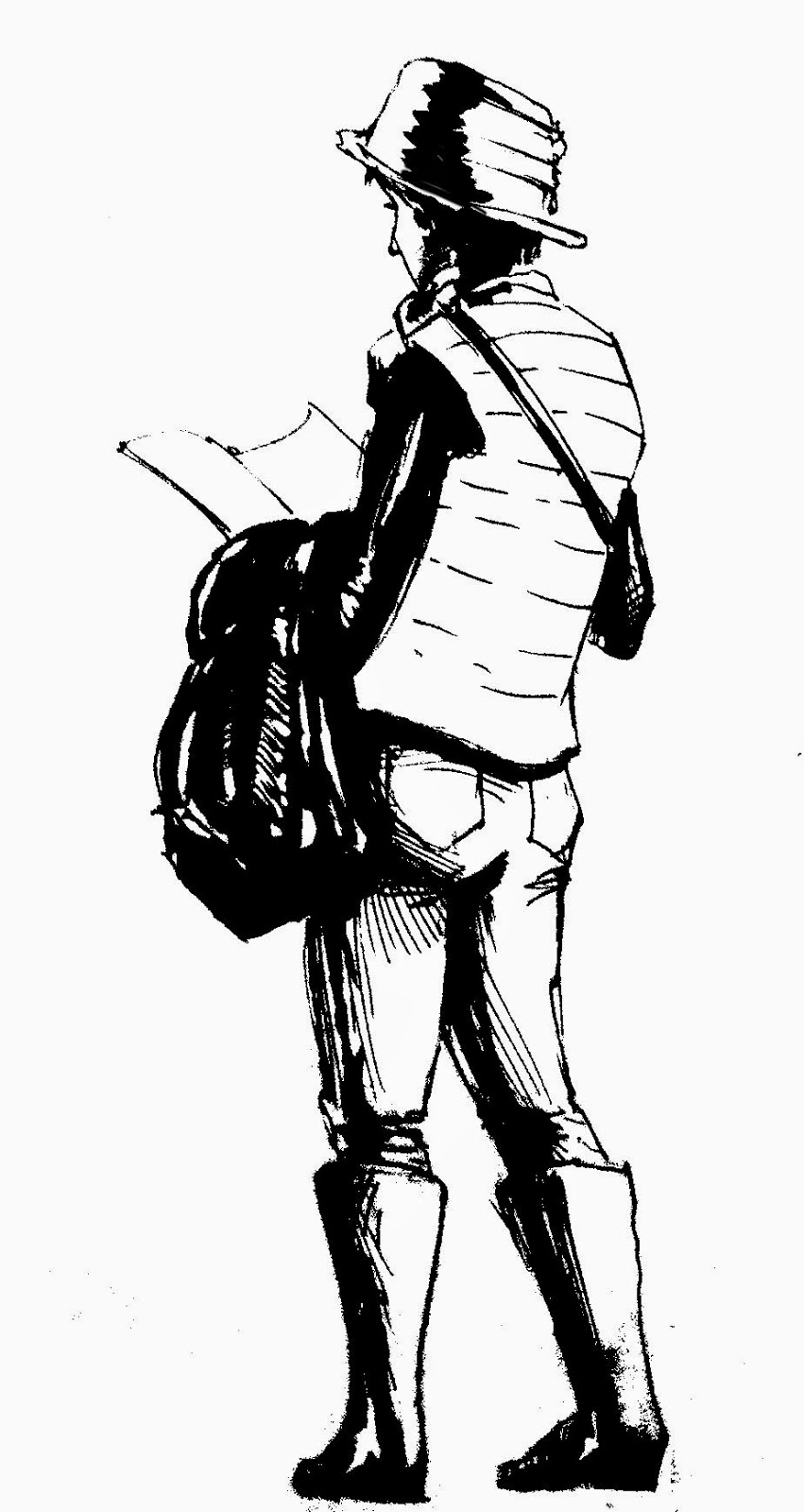 Or "Why Drawing Is So Much Easier Than Writing"
I have to confess - I find drawing and painting to be relatively simple. Let me clarify - I find drawing to be far more novice-friendly than writing. Beginning visual artists usually focus on arrangements of household objects and copies of old masters' paintings. This is a great set of training-wheels, because the Old Masters already did all the hard work of deciding what to put where, and how to apply it - the part that I find the most challenging about the drawing process. And almost any arrangement of objects will look pretty good when rendered.
As your foreknowledge grows, it becomes easier to notice the little details that make a scene more accurate to life. And as you develop your skills, you become more adept at recognizing the thought that went into those masterpieces, but even in the very beginnings of one's "art practice," it's encouraging to finish a piece that actually looks good.
Where is this sort of encouragement to be found in writing? Do we copy the short stories of master writers? Would we learn anything from doing so? Not in any class I've taken, or book I've read on the subject. Maybe you work from a prompt, saving yourself from having to think of whatever question is at the core of the piece. Maybe you try and write "from life" or "stream of consciousness," but that can be pretty turgid stuff, in my experience.
Thank god I don't have to be a writer only (though maybe someday. . . ) Thank god I can dress up a mediocre story with attractive pictures. This seems to be the default mode for a great many writer-illustrators, unfortunately. Some of my favorite comic artists are covering for a weak story (and vice-versa.) Some, like Craig Thompson, can do both with equal alacrity, but how do you get that good at both?
I'm coming to suspect that my assumptions about the process need revising - instead of spending an hour practicing illustration, and another practicing prose writing, I should two hours doing both simultaneously. Because comics is neither writing, nor illustration, but something altogether different.
Friday, December 12, 2014
Daily Sketch - Izzy's Coffee, Asheville NC

Asheville might be my favorite city in the US. The hills surrounding the city are home to thousands of potters and craftsmen of all types, and the city itself is incredibly welcoming to artists, with little bookshops, coffee houses, and any given night you can find fantastic local music echoing out the front doors of the bars. The city is remarkably committed to local businesses and food - when I last visited about 3 years ago I enjoyed some incredible meals across all the price ranges, usually with all local or organic ingredients.

As soon as I finished this painting, a gentleman who had been sitting nearby asked to buy it. Everyday people invested in supporting local artists, and artists who are receptive to it - what a thought!
Process Notes:
I first sketched it briefly in pencil to get a decent perspective, then followed up with a line drawing using the Pentel V5 Precise Pen. It's a little bit water-soluble, so it runs a little when the brush goes over it, but I really like the line it gives, and as I've mentioned before, it's supposed to be archival. Then I started filling in, almost haphazardly, using the watercolor pencils to put in large areas of color, and refining with the portable paint set and the water-brushes. I filled in the darks with the Pentel Brush Pen, and re-added accents with a white-out pen. (I used Bic, but Presto is another good one.)Thursday, December 11, 2014
Daily Sketch - Brash Coffee, Chattanooga

This guy made killer pour-over coffee. One of my favorites so far this trip.
Wednesday, December 10, 2014
On Teaching Yourself Art
 |
| Jolie, 2008, University of New Mexico |
Art School Vs. Self-Taught
Creative work is fantastic - no-one cares about your certifications or degrees as long as you create phenomenal work. Put thus, why would you go to art school?"By their own estimation, the cost of a four year education at RISD is $245,816. As way of comparison, the cost of a diploma from Harvard Law School is a mere $236,100."
-Noah BradleyRequired Reading - IMHO, Don't Go to Art School by Noah Bradley
Or maybe it can help. Or do go to art school - just use it effectively, something I worked at with perhaps 50% success.
"As a student who wants to train in avant-garde cinema, video art, and photography, let’s consider what I’d like to have to shoot one short film:
Sennheiser MKH416 Shotgun Microphone: $1,000
Sound Devices 702T Audio Recorder: $1,975
Associated grip equipment: About $5,000
Sony F3 Digital Cinema Camera + Lensing: $20,000
Production Assistants, DP, Grips: I don’t even want to think about it."
- Mark Kammel
The rebuttal - IMHO Go to Art School, by Mark Kammel
There are so many resources out there, and bloggers like Karen Chang are even nice enough to organize them for us.
Do you want to become a graphic designer? Listen to Karen, who taught herself design, left her job at Microsoft and started making a living doing something she loved instead of something she tolerated.
Karen Chang - How to become a designer without going to design school
Want to learn to draw? Refer to Noah Bradley's post above, and in addition, check out this post on the fantastic blog "Lines and Colors" by Charley Parker
Charley Parker - Learning to Draw
Or not.
The hardest part about making a living doing what you love the most is discovering what that is. What do we love so much that we can practice every day? If you are one of those lucky people who already knows, I think you might be a rarity.
When we see a performer, or look at a painting, all we see are the results of the work, not the work itself. We don't see those "10,000 hours," that Malcom Gladwell talked about in Outliers (Still the best book on genius and success I've ever read).
This quote has been floating around for a while now:
I hope this helps a little bit, I know I'll keep writing here about motivation, about process - all the better to stay focused on the goal - to create really awesome sh*t.
Teaching Yourself - Resources
If, like me, you are currently choosing NOT to attend art school, realize now that you can teach yourself anything you want to know - we literally live in the Matrix. Remember how psyched you were when you saw Neo being jacked in and learning kung fu? Well, we're basically there.There are so many resources out there, and bloggers like Karen Chang are even nice enough to organize them for us.
Do you want to become a graphic designer? Listen to Karen, who taught herself design, left her job at Microsoft and started making a living doing something she loved instead of something she tolerated.
Karen Chang - How to become a designer without going to design school
Want to learn to draw? Refer to Noah Bradley's post above, and in addition, check out this post on the fantastic blog "Lines and Colors" by Charley Parker
Charley Parker - Learning to Draw
Teaching Yourself - Beginning at the Beginning
Now that we have the resources, every expert in every field agrees: Do whatever it is every day. No matter what. Which must take a lot of discipline - certainly it seems impossible to me.Or not.
"People think I have a lot of discipline because I danced every day for 365 days in a row. But the truth is, I have no discipline. I never did anything else for 365 days before. Dance was different because I loved it the most."
- Karen ChangKaren Chang on Discipline
The hardest part about making a living doing what you love the most is discovering what that is. What do we love so much that we can practice every day? If you are one of those lucky people who already knows, I think you might be a rarity.
When we see a performer, or look at a painting, all we see are the results of the work, not the work itself. We don't see those "10,000 hours," that Malcom Gladwell talked about in Outliers (Still the best book on genius and success I've ever read).
"If I miss one day of practice, I notice it. If I miss two days, the critics notice it. If I miss three days, the audience notices it."
- Ignacy Paderewski, Polish pianist and politician.
Where To Go From Here
Okay. You've figured it out! Congratulations, you've just begun a terrifying journey. There are a number of pitfalls you'll encounter - usually entirely of your own devising.This quote has been floating around for a while now:
“Nobody tells this to people who are beginners, I wish someone told me. All of us who do creative work, we get into it because we have good taste. But there is this gap. For the first couple years you make stuff, it’s just not that good. It’s trying to be good, it has potential, but it’s not. But your taste, the thing that got you into the game, is still killer. And your taste is why your work disappoints you. A lot of people never get past this phase, they quit. Most people I know who do interesting, creative work went through years of this. We know our work doesn’t have this special thing that we want it to have. We all go through this. And if you are just starting out or you are still in this phase, you gotta know its normal and the most important thing you can do is do a lot of work. It’s gonna take awhile. It’s normal to take awhile. You’ve just gotta fight your way through.” ― Ira Glass
I hope this helps a little bit, I know I'll keep writing here about motivation, about process - all the better to stay focused on the goal - to create really awesome sh*t.
Some of my other posts on the subject
On Resistance
Subscribe to:
Posts (Atom)